
The Shared Table
What Turkish village food taught me about nourishment.
6/3/20265 min read
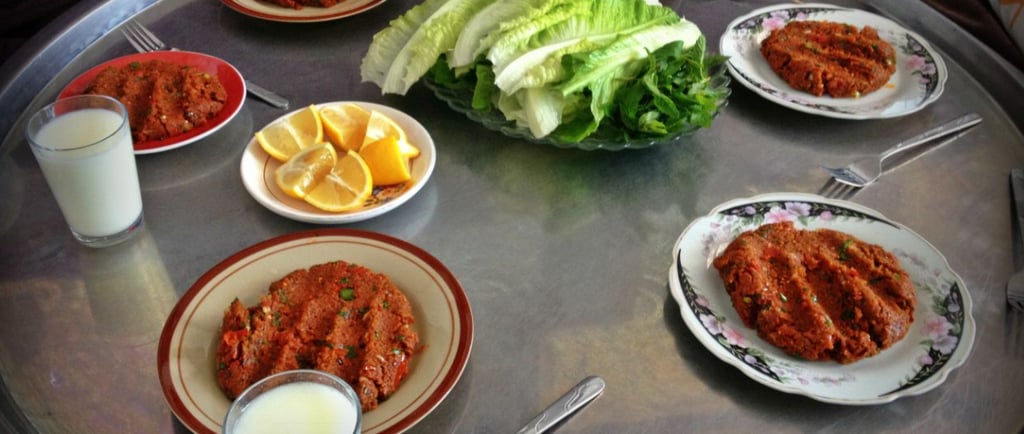
When people think of Turkish or Kurdish food, the first thing that usually springs to mind is kebab. Well, yes, you’ll find kebabs everywhere and every region has its own version, its own method and its own pride. In a Turkish restaurant, especially in tourist areas, you’ll usually see soups, pide, dürüm, chicken skewers, oven kebabs and all the familiar things you'd expect to find. But that is rarely the food served at home.
The food I remember most from village life was much simpler than that. It was seasonal and made with what was available. Food cooked outside. Food carried in pans. Food placed in the centre. Food torn, scooped, dipped and shared with bread.
No fuss. No performance. No individual plating designed to impress. Just food. Just shared. Honest ingredients, cooked with time and care, and eaten with the people around you. That is the food that stayed with me.
The table that wasn’t a table
Traditionally, in the village, there wasn’t really a dinner table in the way we think of one. A cloth would be laid on the floor, and everyone would sit around it, cross-legged. The food would be placed in the middle, sometimes on plates and sometimes still in the pan.
There might be several dishes, but they were not served as separate courses in the formal Western sense. They arrived together and everyone knew what to do.
You reached - not so easy in jeans as I discovered
You tore bread - with your hands
You scooped - with your bread
You dipped - in the same places everyone else did
You shared - the best bit
There would be forks and spoons if needed, especially for soup, but most often bread was the utensil. There were different styles of bread but usually, for lunch and dinner, it would be ufka — a very thin sheet the same sort of thickness as pastry sheets. It is made from flour, water, salt and oil, cooked on a curved cast iron pan over an open fire. That was normally done around 5 am on a Thursday morning by Dursun, Safiye and Ayfare, but I often joined them for tea and a conversation which was always full of laughter. Shop-bought bread existed too, of course, but homemade ufka was the thing that made a meal feel complete.
No one worried about double dipping. Well, I didn't really but I'm sure it can take some getting used to. But village eating has a way of dismantling preciousness, I can tell you that.
Food cooked outside
Although village houses had kitchens, much of the cooking was done outside.
Sometimes in a small purpose-built cooking space. Sometimes completely in the open air. Simple, practical, effective. A fire, a pan, a handful of ingredients, a woman who knows what she’s doing. There is something about that kind of cooking that stays in the body.
The smell of garlic hitting hot oil.
The steam rising from bulgur.
The sharpness of pomegranate syrup.
The coldness of ayran poured into battered metal cups.
The way everyone gathers without needing to be invited.
It wasn’t glamorous. It was better than glamorous. It was alive.
A simple village-style meal
If I wanted to recreate the feeling of a traditional Turkish/Kurdish shared table, I would not start with anything complicated. I’d start with something like this:
Ayran — a cooling yoghurt drink made with thick plain yoghurt, water and a little salt.
Bostani — a chilled tomato, cucumber and rocket salad-soup with onion, chilli and pomegranate syrup.
Chicken with garlic bulgur — simple, rich, comforting and made in one pan.
Ufka or flatbread — for scooping, tearing, dipping and sharing.
It is not fancy food. It is food that knows what it is. And that, to me, that is the best kind.
Bostani: cold, sharp and alive
Bostani is not really a salad in the way we might imagine one. It is more like a finely chopped salad-soup, served very cold. The tomatoes, cucumber, onion and rocket are chopped small, almost delicate, then stirred with pomegranate syrup, chilli, salt and water. It should be fresh, sharp, cooling and alive. The kind of dish that wakes the mouth up.
This you would serve in ind[vidual bowls, but these would be scattered around the tablecloth as families are big and tablecloths are long. They would still be shared. You can, of course, serve it in individual bowls if that feels more comfortable.
Chicken with garlic bulgur
The chicken with garlic bulgur is the kind of dish that teaches you why simple food works. Think, rich olive oil. Butter. Garlic. Chicken. Bulgur. Stock. Salt. Nothing complicated, but everything full of flavour.
The bulgur absorbs it all: the oil, the butter, the garlic, the stock, the juices from the chicken. The second addition of garlic near the end gives it a deeper, fresher edge. It is hearty without being heavy. And it is exactly the sort of dish that belongs in the middle of a table, with bread nearby and people helping themselves.
Ayran: the cooling cup
Ayran is one of those things that sounds almost too simple to be a recipe. Yoghurt. Water. Salt. That’s it. But alongside spicy, salty or richly cooked food, it makes complete sense. Cooling, creamy, savoury and refreshing.
In Turkey, ayran is everywhere, but I don't drink that kind because it is manufactured and sold in little plastic pots. It tastes horrible. But, homemade ayran has its own charm and it is delicious. You can make it in a jug, a bowl, or with a blender. It should be thin enough to drink, almost the consistency of milk, and served cold.
I always think of it as the opposite of overcomplication. Three ingredients. Perfectly useful. Perfectly enough.
What village food taught me
Living in Turkey taught me many things and changed my perception of many things too. But dinners at the village became one of my favourite things to do and food taught me something I still carry into my work now.
Food is not just fuel.
It is not just calories.
It is not just macros, labels, grams, rules or points.
Food is memory.
Food is care.
Food is family.
Food is belonging.
Food is culture.
Food is rhythm.
Food is the way a house gathers itself.
Inside The Well, this is the kind of nourishment I want to return to. Not perfect food. Not expensive food.
Not food that needs a wellness label to justify itself. Real food.
Simple ingredients.
Shared tables.
Seasonal rhythms.
The wisdom of making something from what you have.
The pleasure of eating with gusto.
Because somewhere along the way, many of us became disconnected from food. We were taught to count it, fear it, restrict it, perform it, photograph it, improve it. But it was always meant to be more intimate than that.
It was meant to be touched.
Torn.
Shared.
Smelled.
Tasted.
Passed across the table.
It was meant to nourish more than the body.
Afiyet Olsun
At start of a Turkish meal, you’ll often hear:
Afiyet olsun.
Which roughly means “bon appétit,” but like many phrases, it carries more feeling than its translation. It is a blessing of sorts.
May it be good for you.
May it nourish you.
May you enjoy it.
May it bring you health.
Doesn't that feel like the perfect phrase for The Well? I think so.
Eat with gusto.
Laugh loudly.
Tear the bread.
Scoop from the middle.
Let food be simple again.
I love that.
If you're member of The Well, the full recipes can downloaded in the members only section.
With love,
Kym x